
How to Search the Dakota County Court Docket
Start with Minnesota Court Records Online, or MCRO. It is the statewide system that replaced the older MPA Remote service. MCRO is the public entry point for a Dakota County court docket. You can search by person or business name. Attorney name or bar number, complete case number, and citation number also work. To narrow a broad search, choose Court Locations, select County, and check Dakota. A complete case or citation number is usually the fastest route. It cuts down false matches.
Know what you are looking for before you search. A Dakota County court docket result might be a case card. It might also be a hearing result, a document list, or a judgment detail. Each one carries different information. Save the search date, the Dakota County filter, and the exact terms you used. Remember that a charge, a warrant label, or a scheduled hearing is not a final outcome. Is a Dakota County search result unclear? Do you need a certified copy? Court Administration can answer local-record questions.
- Open the public MCRO portal and select the Dakota County location filter.
- Use the complete case or citation number when known, or enter a name with careful spelling variants.
- Open Case Details to review the Register of Actions and dated Case Events.
- Use Hearing Search for a setting, then compare it with the Dakota County daily calendar.
- Ask Dakota County Court Administration for complete public access or an official copy when online access does not answer the request.
Note: A Dakota County court docket search works best when the search type matches the record you want.
Dakota Court Docket Search Tabs
MCRO splits its work into four tabs. They are Case Search, Document Search, Hearing Search, and Judgment Search. Case Search identifies a Dakota County case. Document Search requires a complete case number. It returns a reverse-chronological list where access is allowed. Hearing Search works with a person, case, judicial officer, attorney, or date range. Judgment Search targets docketed money judgments and satisfactions. It is not a tool for general case searching.
The official MCRO overview describes the current public system and its limits. Whether a document can be viewed depends on case type and filing date. Confidentiality, sealing, and Minnesota public-access rules also govern access. A Dakota County event may appear even when its document stays hidden remotely. That is a signal to try a courthouse terminal or call Dakota County Court Administration. It is not a reason to assume the event never occurred.
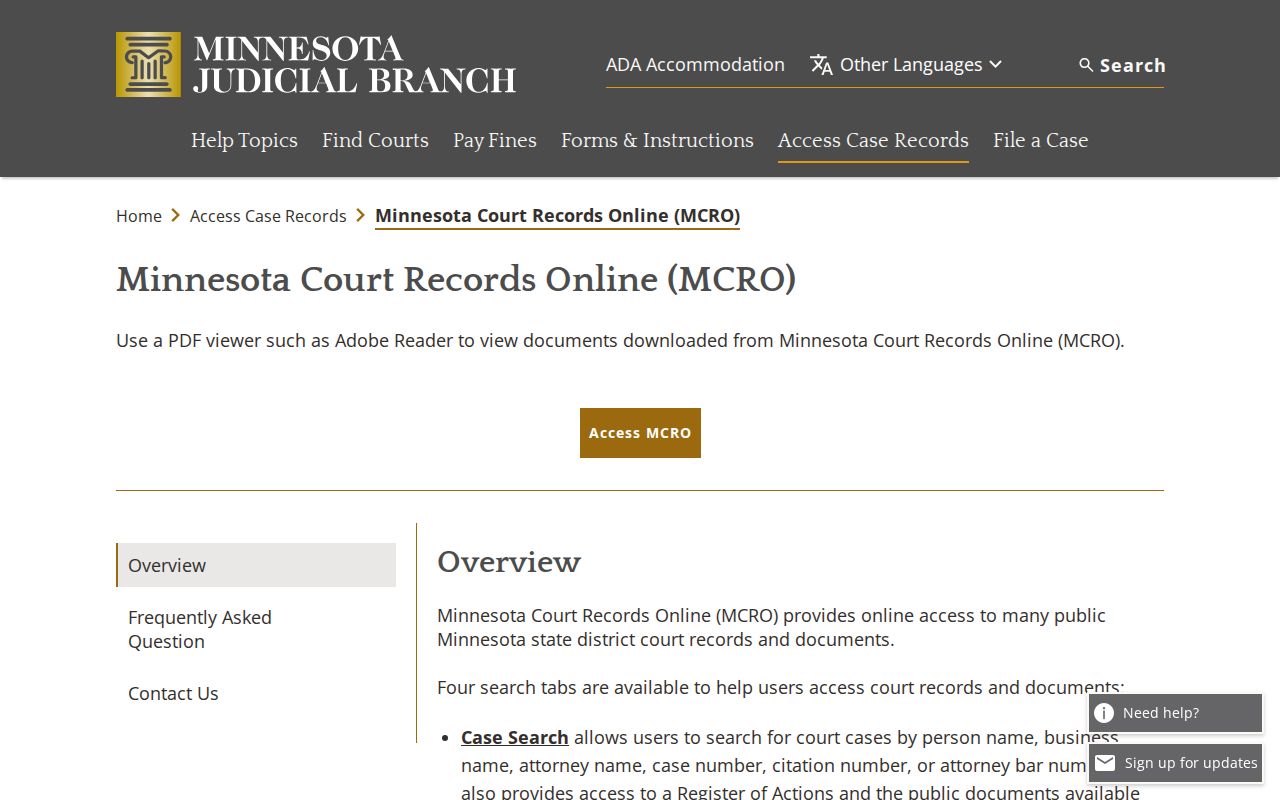
The MCRO view serves as a public index for Dakota County cases, hearings, documents, and judgments. Still, the channel you choose controls what can be seen.
What a Dakota County Court Docket Shows
In MCRO, Dakota County users will see a formal label. It reads Case Details (Register of Actions), along with Case Events. The docket is a running record of court activity, not a simple case summary. It can show the court file number, title, type, filed date, court location, judicial officer, status, citation number, parties, and attorneys. Where public access permits, criminal records also show charges and bail activity. Warrants, conditions, dispositions, and sentencing appear there too.
Case Events tie the history together. An event description and document index number identify a filing, order, hearing-related entry, payment, or other activity. Financial information can list fines, fees, payments, and credits. The docket may also link to a related case. Read a Dakota County court docket by date and event type. A filing is not a hearing setting. A final judgment means something different again.
| Case Details | The MCRO Register of Actions view for a Dakota County case. |
|---|---|
| Case Events | Dated docket activities, filing descriptions, and available document links. |
| Hearing | A setting with date, time, location, type, and sometimes connection mode. |
| Case status | A broad open or closed indicator, not a complete account of obligations. |
| Disposition | The recorded outcome of a charge, claim, or case, which must be read with the event history. |
Dakota Court Docket Terms
Plain terms keep a Dakota County docket from being read too quickly. An arraignment is an early criminal appearance. An omnibus hearing is a criminal pretrial setting for evidentiary, procedural, and related issues. A disposition is a recorded outcome. It is not the same as a new setting or a filed motion. The calendar’s Connection Type describes how a hearing is connected. It may be in person or remote.
- Document Index Number
- The docket identifier connected to a document or event link.
- Conciliation
- Minnesota’s lower-dollar civil process within the District Court structure, often called small claims.
- Venue or Court Location
- The Dakota County service location associated with the case, such as Hastings, Apple Valley, or West St. Paul.
- Satisfaction
- A docketed indication that a judgment obligation was paid or otherwise satisfied.
Use the full event history before drawing a conclusion. A Dakota County charge is an allegation, and a warrant flag requires official confirmation. The same care applies to a case marked closed. Closed status does not explain every later payment or related proceeding.
Which Dakota County Courts Keep Dockets
Dakota County has one unified District Court. It sits within Minnesota’s First Judicial District. The county has no network of separate municipal courts. That court holds original jurisdiction for civil, family, probate, juvenile, criminal, and traffic cases filed in the county. Its divisions include Criminal/Traffic, Civil/Conciliation, Family, Guardianship/Conservatorship, Juvenile, Probate/Mental Health/Adoptions, and Treatment Courts. A city police department may originate a citation. Even so, its Dakota County court docket is still a District Court record.
| Court or division | Docket covers | Where to search or ask |
|---|---|---|
| Dakota County District Court | Criminal, traffic, civil, family, probate, juvenile, and related trial-court cases | MCRO, a public terminal, or Dakota County Court Administration |
| Civil and Conciliation | Civil claims and Minnesota conciliation matters | MCRO Case Details and the Civil division |
| Treatment Courts | Specialized District Court programs, subject to heightened privacy limits | The official divisions page or Court Administration |
| Minnesota Court of Appeals | Appeals from District Court judgments and orders | Appellate records, rather than the Dakota County trial docket |
A qualifying conciliation matter can move up later. After removal for a new trial, it gets its own District Court file. Two records may exist for one dispute. If MCRO shows a conciliation case and a later civil action in your Dakota County record search, note both file numbers. The state route is covered by the public Minnesota appeals information.
Dakota Court Division Dockets
Why does a general docket search sometimes need a division call? The Dakota County court divisions page explains. Criminal and traffic matters, civil and family questions, and probate and mental health matters each take different procedural paths. So do juvenile files and treatment-court programs. Probate, mental health, adoptions, and juvenile work are identified as Hastings-only. That location detail matters when a public record exists. It may require in-person review.
The same official Dakota County court divisions page maps the specialized routes and their limits. A public case event does not authorize access to sensitive treatment, family, juvenile, or adoption information. Dakota County Court Administration can route a question to the proper division. The record custodian does not change. The court stays unified even though its services are divided.
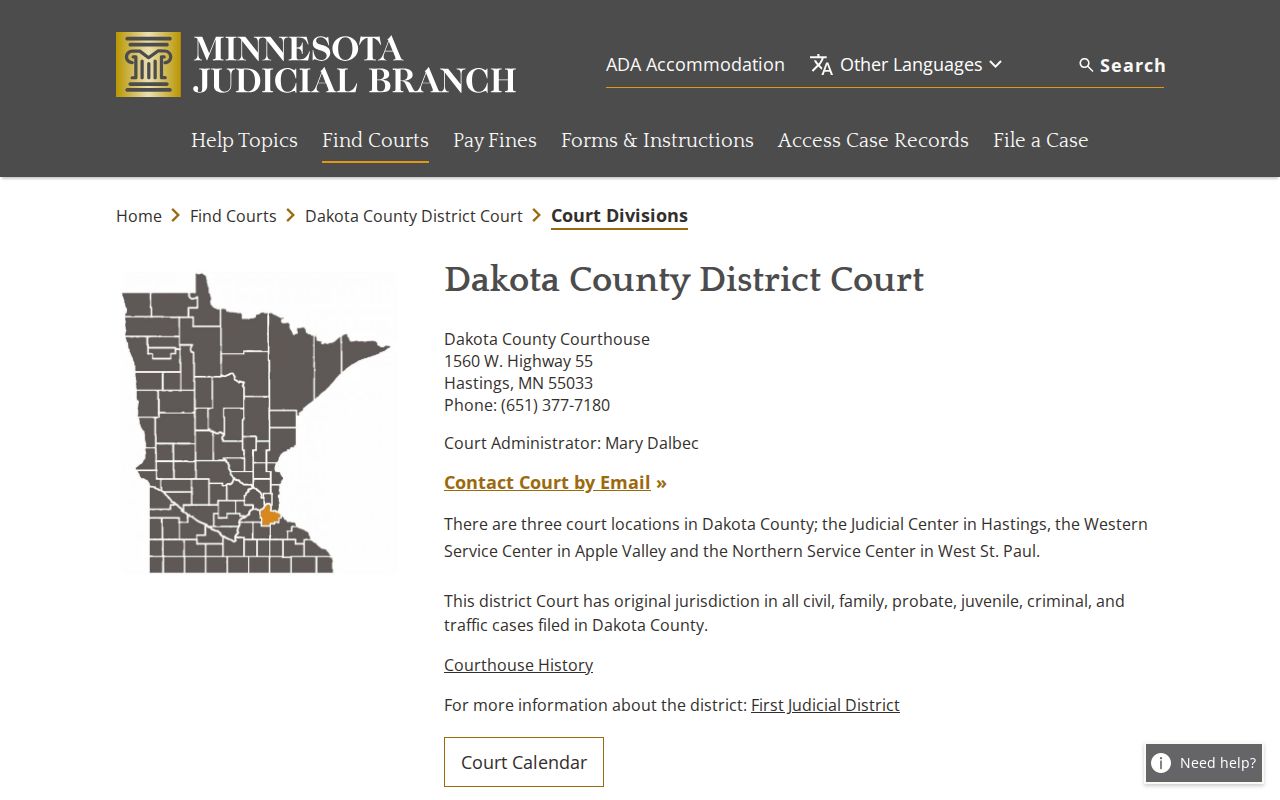
The Dakota County division structure offers a practical way to identify the right service route. Knowing it first saves effort when you make a records request.
Finding Dakota County Court Dates and Settings
Start with the daily public calendar, a searchable PDF covering Dakota County hearings. Each line shows the hearing location, hearing date, time, judicial officer, hearing type, Connection Type, and case number. It is an operational list. MCRO Hearing Search works better for settings further out or already past. Case Events give the fuller court history over a case's life. Remember one thing. A hearing date on a docket can be set, moved, or continued. That alone signals no final disposition.
The calendar posts at roughly 7:00 p.m. for the next day. It then updates hourly from 7:00 a.m. through business hours. It does not capture every matter. Printed calendars outside courtrooms and lobby displays can run more current. If a hearing truly matters, confirm the place, time, courtroom, and connection method through Dakota County Court Administration. The same applies when the calendar conflicts with MCRO. A calendar listing is a scheduling aid. It is neither a permanent archive nor a final ruling.
Dakota Court Calendar Limits
Dakota County's daily calendar has real limits. It can omit confidential matters. It can also omit records barred from remote access under Rule 8, subdivision 2 of the Minnesota Rules of Public Access. So a missing line proves nothing. A Dakota County case can be canceled, rescheduled, or simply unlisted. The calendar is also separate from MCRO Hearing Search. One publishes the next-day schedule. The other searches hearings statewide through the portal. For current local routing, the official Dakota County court landing page stays the source to trust.
Labels carry meaning only in context. Dakota County examples run from arraignment and first appearance to pre-trial, omnibus hearing, motion hearing, eviction hearing, jury trial, sentencing, and conciliation hearing. A filing or a payment can appear as a Case Event with no hearing attached. A calendared hearing can also be continued later. Dakota County's written criminal continuance policy weighs timing and prior continuances heavily. Always confirm a scheduled event through the official court.
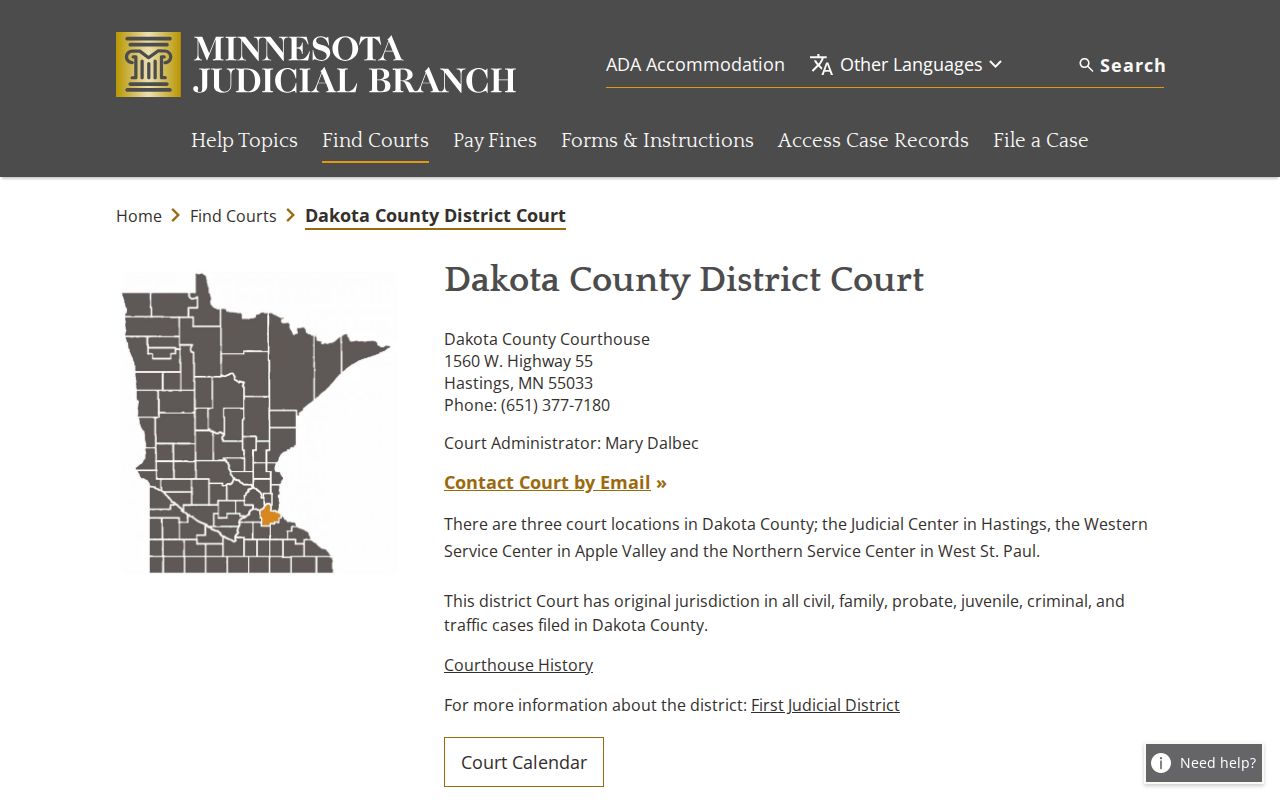
For service locations, calendar links, and local routing, the Dakota County court landing page is the current source. It beats guesswork every time.
Public Access to Dakota County Court Dockets
Public access to Dakota County judicial records rests chiefly on the Minnesota Rules of Public Access to Records of the Judicial Branch. A routine county data request will not open them. Rule 4 gives the general framework for what counts as a public judicial record. Rule 8 sets the remote-access limits and exceptions. Both matter for docket work. A public file can still hold a document unavailable online, and a public calendar can omit a confidential matter. When MCRO shows nothing, turn next to the courthouse. Dakota County courthouse access and Court Administration handle a docket or court records request.
Key Dakota County access rules:
Minnesota Rules of Public Access, Rule 4 sets the general public-access categories for judicial records.
Rule 8, subdivision 2 limits remote access to specified confidential proceedings and documents.
Rules 11, 11.1, and 11.2 forms help protect restricted personal identifiers in filings.
Minnesota Statutes section 13.03 addresses executive-branch government data, such as a city police record, rather than controlling the judicial docket.
Some material stays closed. Sealed, confidential, adoption, and other restricted records can require identity verification, a specific form, or an access order. A confidential-information form only shields identifiers in a filing. It is not a request to unseal a Dakota County court record.
Dakota Docket Access Channels
Dakota County gives the public more than one route to a docket. MCRO serves as the remote search layer. Courthouse electronic terminals offer the deepest electronic public access. Each courthouse also opens its counter to locally stored paper records. Court Administration answers record-specific questions. It handles copy and certification requests, and it routes people to the right division. The court's access page offers a warning. An online Dakota County docket result should never be mistaken for the full official record.
The Minnesota court structure overview situates Dakota County District Court inside the statewide trial-court system. Three service locations serve the county. The Judicial Center sits at 1560 West Highway 55, Hastings, Minnesota 55033, telephone 651-377-7180. The Western Service Center is at 14955 Galaxie Avenue West, Apple Valley, Minnesota 55124, telephone 952-247-7099. The Northern Service Center sits at 1 West Mendota Road, Suite 140, West St. Paul, Minnesota 55118. Its telephone number is 651-377-7190. All list hours of 8:00 a.m. to 4:30 p.m., Monday through Friday. Holidays are excluded. Before traveling for a sealed, archived, or paper-only file, call Dakota County Court Administration.
Dakota County District Court sits at the trial level of Minnesota's three-tier state system. The Court of Appeals and Supreme Court sit above it.
The Dakota County Clerk and Docket Records
Minnesota handles this work through Court Administration rather than a separate elected county clerk. For Dakota County docket work, that office receives filings, keeps the court file and register of actions, manages calendars and courtroom assignments, provides public access, and processes copy and certification requests. Even when a public page names the current Court Administrator, the office itself remains the stable records contact. Requests for a court-certified judgment, docket, filing, or case copy should go there. Not everything does. A police incident report belongs with the law-enforcement agency that wrote it, and county attorney and public defender working files sit with those offices.
Division phone lines help with routing. Dakota County criminal and traffic questions use 651-377-7188. Civil uses 651-377-7900. Probate, Mental Health, and Adoptions use 651-377-7974. Juvenile also uses 651-377-7188.
Dakota County District Court Court Administration
Dakota County Judicial Center
1560 West Highway 55, Hastings, MN 55033
651-377-7180
Dakota Court Record Copy Fees
A Dakota County docket is an index plus an event history. Behind it sit the actual documents: pleadings, motions, affidavits, orders, judgments, notices, and exhibits. MCRO Document Search needs the complete case number. Without it, nothing works. Even then, a listed document may be confidential. It may be unavailable remotely, or outside the covered date range. Remote access can run short. In that case, a courthouse terminal or Dakota County Court Administration may offer the proper public route into the court records.
| Dakota County copy type | Current listed charge |
|---|---|
| Uncertified instrument, printout, scan, or screen print | $0 |
| Certified copy | $14 per document |
| Exemplified copy | $14 |
| Exemplified and certified copy | $28 |
| Scanning | $25 per 50 pages or part |
The Dakota County fee table lists copy charges plus report costs. Fees can change. They may also be reduced or waived.
Court Dockets by City in Dakota County
Dakota County's five largest cities are Lakeville, Eagan, Burnsville, Apple Valley, and Inver Grove Heights. That ranking comes from the 2020 Census. None of them runs its own municipal-court docket portal. That surprises some people searching a city name. A city police department or local traffic page can still help by naming the agency that issued a ticket or charge. But the actual court docket search always points back to Dakota County District Court. Case lookups go through four channels. These are MCRO, the daily calendar, Court Administration, or the Minnesota Court Payment Center. Criminal, traffic, and court-file records all live in the same county-level systems, no matter which city the case came from.
Lakeville Court Docket
69,490 in the 2020 Census. Lakeville police and victim-service pages provide local context; the court docket stays with Dakota County District Court.
Eagan Court Docket
68,855 in the 2020 Census. Eagan’s traffic materials identify city roadway context, while court records remain in the Dakota County system.
Burnsville Court Docket
64,317 in the 2020 Census. Burnsville directs parking and traffic ticket questions to Dakota County District Court.
Apple Valley Court Docket
56,374 in the 2020 Census. Apple Valley hosts the Dakota County Western Service Center but does not have a separate court docket portal.
Inver Grove Heights Court Docket
35,801 in the 2020 Census. City citation routing leads to Dakota County service centers and the unified District Court.
Dakota Docket Technology Timeline
Docket access in Dakota County has shifted over time. Older instructions pointed people to MPA Remote. That system has since given way to MCRO, the current public platform for a Dakota County court docket search. Minnesota's own history marks the milestones. Document Search arrived in March 2021, and Case Search followed in December 2021. Hearing Search and Judgment Search both launched in August 2022. So an old MPA Remote link is not a working portal today.
Assignments and filings move through other channels. The official Dakota County judicial directory shows who currently sits on which cases. Authorized attorneys file through Minnesota eFile and eServe, which is not a public docket viewer. The Dakota County calendar PDF is separate from both tools. With this many overlapping systems, a good search starts by naming what you need: a case index, a document, a hearing, a judgment, a calendar entry, a certified copy, or an executive-agency record.
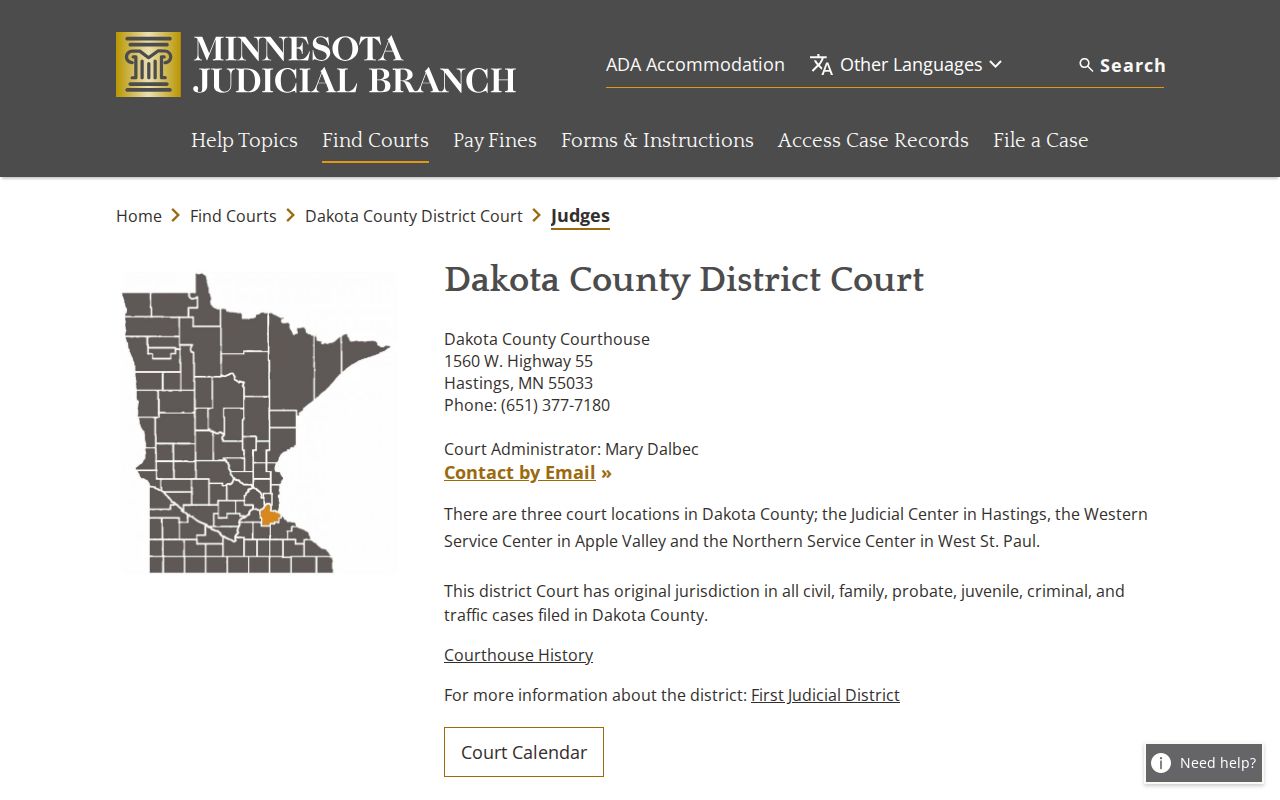
For current judicial assignments, check the live Dakota County judicial directory. Judges change assignments on their own schedule, apart from any docket search.
Map and Directions to the Dakota County Judicial Center
Dakota County's countywide anchor for district-court records is the Dakota County Judicial Center in Hastings. Probate, mental health, adoptions, and juvenile matters are handled only at this Hastings location, while criminal/traffic and civil/family filings can also be reached through the Western Service Center in Apple Valley or the Northern Service Center in West St. Paul. Call the relevant division before traveling if the request involves a sealed, archived, or paper-only file.
Dakota County Judicial Center
1560 West Highway 55
Hastings, MN 55033
651-377-7180
Monday-Friday, 8:00 a.m.-4:30 p.m.
Western Service Center
14955 Galaxie Avenue West
Apple Valley, MN 55124
952-247-7099
Monday-Friday, 8:00 a.m.-4:30 p.m.
All three Dakota County court locations keep the same 8:00 a.m. to 4:30 p.m. weekday hours. Point-of-entry security screening should be expected at any of the buildings; the county's public-safety page did not expose detailed rules on laptops, lockers, or prohibited items in the reviewed material, so confirm current entry procedures with Court Administration before a visit. The Hastings Judicial Center is not the same building as the County Administration Center at 1590 Highway 55, which is county administration rather than the court's record counter.