
How to Search Criminal Dockets
Start at Minnesota Court Records Online, called MCRO. The Case Search tab takes a person or business name, an attorney name or bar number, a complete case number, or a citation number. Then narrow things down. Choose Court Locations, select County, and check Dakota. A full case number or citation typed without spaces is the fastest route when you have it. Dashes and leading zeroes are optional. Type a partial number, though, and the system throws an error.
Name searches take more care. MCRO matches names exactly unless you switch on its wildcard or Sounds Like option. Those two should never be combined. A stray middle initial, suffix, or different spelling can change what comes back. For common names, add a filed-date range, case status, or category. Open the result as Case Details. That is the official Register of Actions view, so do not trust the result card alone.
- Open MCRO Case Search and set the court location filter to Dakota County.
- Enter a complete case or citation number, or use a carefully narrowed name search.
- Open the matching Case Details record and check the case type, court location, and parties.
- Read Case Events and upcoming hearings with the search date in mind.
- Use Court Administration for a certified copy, paper record, or question that MCRO cannot answer.
Note: MCRO technical help cannot handle a Dakota Court Administration request for a case-specific record or current court instruction. Those go to the court itself.
Dakota County Criminal Docket Fields
MCRO offers four separate public searches: Case, Document, Hearing, and Judgment. Criminal work usually leans on the first two of Case Search and Hearing Search. Hearing Search filters by person, complete case number, judicial officer, attorney, date or date range, and category. It also has a Dakota location filter. A hit answers one scheduling question. It is not the county's full daily calendar. And it does not prove the hearing ever took place.
| Search goal | MCRO tab | Useful Dakota filter |
|---|---|---|
| Find a criminal case | Case Search | County, case status, category, filed date |
| Find a future or prior setting | Hearing Search | Dakota location and hearing-date range |
| Find a filed document | Document Search | Complete case number required |
The Minnesota Judicial Branch publishes its current rules through an official court-rules source, maintained as a living dashboard. Why does that matter here? Because a Dakota County criminal docket can list a case event while the document behind it stays closed to remote access.
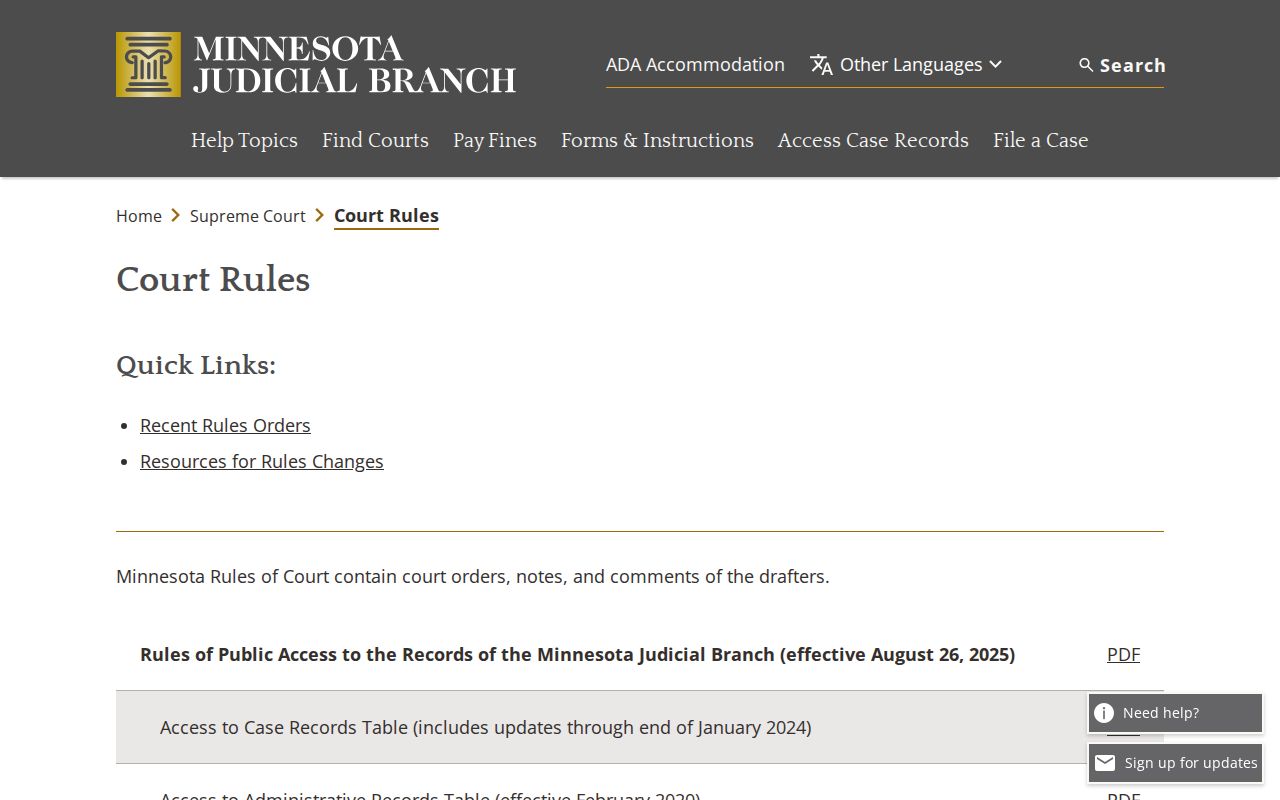
For Dakota criminal dockets, Rule 8 keeps some records off remote access even when the case metadata shows up in MCRO.
What a Criminal Docket Shows
The synthetic Case Details field map in MCRO shows why a criminal docket is more than dates on a page. The overview can surface upcoming hearings and financial amounts. Case Information covers the case number, type, filing date, venue, judicial officer, status, citation number, and related cases. Criminal sections may list charges, amendments, interim conditions, warrants, bond or bail activity, dispositions, and sentencing. Case Events add dated descriptions, document index numbers, and links wherever a document can be viewed.
| Case number | Use the complete Dakota criminal file number, such as 27-CR-26-00000, only as a format example rather than a real case. |
|---|---|
| Charges | Alleged offenses and any amended charge history, not a finding of guilt. |
| Hearings | Scheduled dates, times, locations, hearing types, and sometimes a connection method. |
| Events and documents | Dated docket activity and document index numbers; remote viewing can be limited. |
| Disposition and sentence | The recorded outcome and, when applicable, sentencing information after a plea or conviction. |
A charge is an allegation, not a result. A warrant is not an outcome either. A disposition is the entry that records what the court actually did with a charge or the case. An active-warrant label deserves direct confirmation through the proper court or law-enforcement channel, never a dated screen treated as a live status guarantee.
Dakota County Criminal Terms
Calendar labels and docket fields mark different moments in a criminal matter. Dakota's public calendar has listed arraignment, first appearance, omnibus hearing, pre-trial, court trial, jury trial, sentencing, and other settings. Each term gives context. Still, only the Case Events history and any later disposition tell you what happened after a scheduled event came and went. A listed setting alone is not a result.
- Arraignment
- An early criminal appearance addressing the charge and initial process.
- Omnibus hearing
- A criminal pretrial hearing that can address evidentiary, procedural, and related issues.
- Interim conditions
- Conditions imposed while a criminal case remains pending.
- Bond or bail activity
- The docket history of bail or bond amounts and status, rather than a final case result.
- Disposition
- The recorded court outcome, such as dismissal, plea result, or other resolution.
Sentencing comes after a plea or conviction, once a sentence must be imposed. It is not a charge. That distinction matters when an earlier result card sits beside newer case events on the same docket.
Stages on a Dakota County Criminal Docket
A Dakota criminal case can pass through several docket stages. A filing or charge may lead to a first appearance or arraignment, then an omnibus hearing, pre-trial work, motions, a plea, a court or jury trial, a disposition, and sentencing. No case hits every stage. The same case can also collect multiple settings as dates get continued or new issues arise.
Docket flow: Filing or Charge › Arraignment or First Appearance › Pre-trial or Omnibus › Plea or Trial › Disposition › Sentencing
Read the event date, the event description, and later entries as one story. An open or closed status is just a broad label. It cannot stand in for the history of individual charges, orders, payments, or post-disposition events.
Dakota County Criminal Calendar
Need tomorrow's criminal hearing details fast? Check MCRO Hearing Search first. Then cross-check the official Dakota calendar instructions and the daily PDF. That PDF posts at about 7:00 p.m. for the next day. It then updates hourly from 7:00 a.m. through business hours. Handy as it is, the Dakota County criminal calendar skips some matters. Confidential or non-remotely accessible items can be left off under Rule 8.
Each entry shows fields like Hearing Location, Hearing Date, Time, Judicial Officer, Hearing Type, Connection Type, and Case Number. Verify the place and how to connect shortly before the hearing. The most current operational sources are the printed calendars posted outside courtrooms. The electronic lobby displays serve the same purpose. Remember that a scheduled setting can be continued. A current PDF is not a permanent archive of the docket.
Missing a historical date? Search the Hearing tab, then call Dakota County District Court Court Administration. The separate Dakota County Court Calendar resource covers timing and field meanings in more depth.
Which Court Holds Criminal Dockets
Dakota County District Court handles all criminal and traffic cases in the county. It serves as the trial court of original jurisdiction. A citation from a city police department or an arrest by another agency does not create a separate municipal-court docket. Instead, the court's Dakota divisions page routes criminal and traffic questions through the District Court structure. MCRO searches statewide records by county and case category.
Dakota County runs several service locations. Yet it remains a single county District Court rather than a set of independent local criminal courts. Court Administration manages the district-court files, public counter access, calendars, copies, and certification. The First Judicial District office plays an administrative role only. It is not a second criminal trial court.
Dakota County Criminal Custodians
A records request works best when it reaches the office that actually holds the item. Court Administration keeps the court docket, filed pleadings, orders, judgments, and certified copies. An arresting police agency may hold an incident report. It may also hold photographs, body-camera material, or evidence. The county attorney may hold prosecution materials. These are related records. They are not interchangeable copies of the court docket.
Dakota Criminal and Traffic
For a Dakota court file, calendar, copy, or division question, use Dakota County District Court Court Administration.
651-377-7188
Official Dakota Court Administration contacts list division and location routing.
When remote MCRO access falls short, in-person access still matters. Public terminals are available through the Judicial Branch. Each courthouse also provides counter access to locally stored public paper records. For a mail copy request, use the appropriate Court Administration location or division. It is listed on the official contact page.
Public Access and Sealed Criminal Dockets
Minnesota judicial records follow the Minnesota Rules of Public Access to Records of the Judicial Branch. A court file is different. You do not obtain one through an ordinary Minnesota Government Data Practices Act request. Rule 4 sets the public-access framework. Rule 8 controls remote access and its exceptions. A case can exist. Its documents may sit confidential, sealed, available only at a courthouse terminal, or outside the period of remote coverage.
Public criminal documents filed on or after July 1, 2015 are generally available through MCRO for major and minor criminal matters. The exceptions still apply. Older records and restricted material need a different route. Court Administration can explain the right channel, and the official copy-request process handles permitted copies and certification. An unavailable document is not necessarily absent from the court file.
Key Rules: Minnesota Rules of Public Access, Rules 4 and 8 set the public-access framework and remote-access limits for judicial records.
Restricted identifiers use designated confidential-information procedures; a court order or the correct access process may be required for sealed material.
Dakota County Criminal Expungement
Expungement is a court process. It is not a promise that every government record or news archive disappears. What a public viewer sees depends on the resulting order. The MCRO coverage rules matter too. So do the public-access rules. Dakota's criminal and traffic division links to official expungement resources. Eligibility and procedure still turn on the applicable form, the court process, and current legal guidance.
The official profile for Bryce A.D. Ehrman is a Judicial Branch source showing Dakota criminal-court leadership context. Judicial assignments can change, though. A profile won't tell you who will hear a specific case.
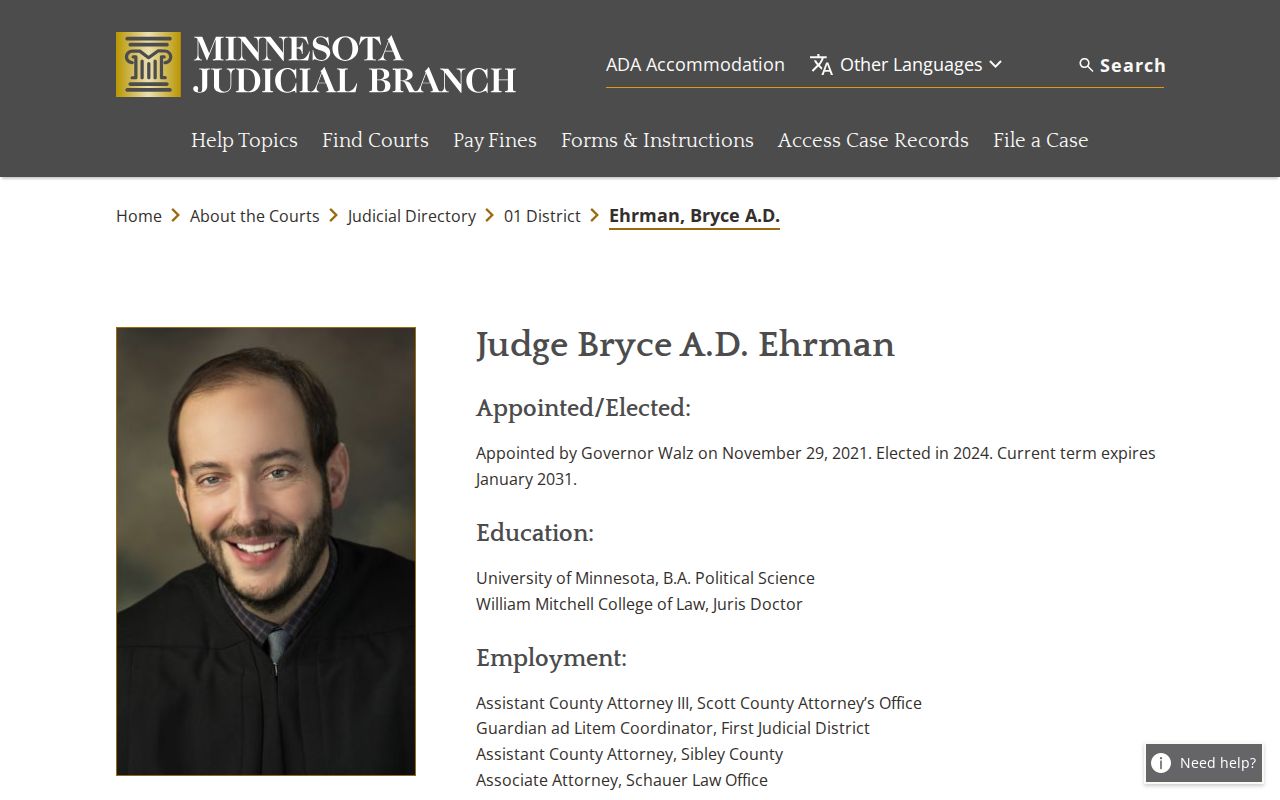
To confirm present courtroom and division routing, use the current Dakota court directory or Court Administration. A historic docket image will not answer that question.