
How to Get Court Records
Every Dakota County court file lives with Court Administration at the District Court. Bring the complete court file number. Through Minnesota Court Records Online, you can find a case and view whatever Case Details or documents it allows remotely. That view is convenient. It is not the certified record, and it does not replace the court's public-terminal access.
- Search MCRO by case number, name, business, or citation and save the Dakota County case number, document title, and date if available.
- For fuller electronic access, use a courthouse public terminal. The Judicial Branch describes terminals as the most complete electronic public-access channel.
- Ask at the Dakota County court counter for locally stored public paper records or call the relevant division before visiting for a paper, archived, or restricted file.
- Use the official copy-request route for a plain, certified, or exemplified copy. A mailed request should identify the county, court file number, requested document or date, copy type, contact information, and payment or delivery details.
- A party may eFile a copy request into the case through Minnesota eFile and eServe. A non-party may need an administrative file number supplied by Court Administration.
Mail requests are allowed too. The statewide copy-request instructions explain how, and they note that the eFile option only works for a request inside an existing case. Questions about a Dakota County record, a paper file, certification, or restricted access go to Court Administration, not to MCRO technical support.
Dakota County Court Record Documents
A docket is an index with an event history. The entries point to real documents. Those can include pleadings, motions, affidavits, orders, judgments, notices, exhibits, and other filings. To use MCRO Document Search, you need the complete case number. Results appear as a reverse-chronological list. Match each item by its event description and document index number. That ties back to the Dakota County docket.
One catch trips people up. A case event can appear while its document stays hidden. The document may be confidential, sealed, or outside the remote date range. It may also be in a Rule 8 category unavailable online. So name the document or event date in your request. Asking for everything on a result card is too vague.
- Register of Actions
- The formal MCRO Case Details view with the case summary and event history.
- Case Event
- A dated docket activity or filing description, not necessarily the document image itself.
- Certified copy
- A copy that bears the court certification or seal.
- Exemplified copy
- A copy carrying the additional authentication described by the Judicial Branch.
Types of Court Records
The record type decides where you go. Court Administration holds the judicial case material. A police department keeps its own reports from a citation or an investigation. The county attorney and public defender each hold working files. A court-certified judgment comes from the court. A police incident report comes from the agency that wrote it.
- Case Details, the Register of Actions, and dated case events.
- Pleadings, motions, affidavits, notices, and court orders.
- Judgments, dispositions, financial entries, and satisfactions where applicable.
- Hearing information and public calendar entries.
- Plain, certified, or exemplified copies of eligible court documents.
Executive-branch data works differently. The Minnesota Government Data Practices Act controls it. Chapter 13 may govern a county or city record, yet it does not replace the Judicial Branch process for a Dakota County court file. And no data-practices request opens a sealed court file as ordinary county data.
Dakota County Court Administration
Court Administration does the daily work. The office receives filings, keeps case files and registers of actions, manages calendars and courtroom assignments, handles public access, and processes copy and certification requests. Minnesota does not hand Dakota docket work to a separately branded elected county clerk. The name stays the same. It is Dakota County District Court Court Administration.
Dakota County Judicial Center
1560 West Highway 55
Hastings, Minnesota 55033
651-377-7180
The contact list splits questions by division. Criminal and Traffic go to 651-377-7188. Civil goes to 651-377-7900. Probate, Mental Health, and Adoptions go to 651-377-7974. Locations sit in Hastings, Apple Valley, and West St. Paul. Probate, mental health, adoptions, and juvenile matters carry location or access limits. So call before you drive over.
What a Court Record Contains
What sits inside a Dakota County court record depends on case type and access level. MCRO publishes a synthetic Case Details guide. It names the main fields without using a live party record. Context still matters when you read one. A filing or order connects to a docket event, but a scheduled hearing is not a disposition. An allegation, likewise, is not a finding.
| Case information | Case number, case type, filed date, location, judicial officer, status, citation number, flags, and related cases. |
|---|---|
| Party and attorney information | Roles, limited identifying fields, aliases, and attorneys as displayed under the applicable access rules. |
| Case events | Event descriptions, document index numbers, and document links when remote access is allowed. |
| Hearing and disposition data | Upcoming settings, case events, dispositions, and judgment details that may answer different procedural questions. |
| Financial information | Fines, fees, payments, credits, monetary awards, and satisfactions when present in the case. |
Need the official field map? The statewide Case Details and Judgment Details handout supplies it. The handout also shows why a judgment entry, a payment, and a case status describe different things.
Dakota County Court Record Requests
Name what you want. A solid request gives the Dakota County court file number, the document or date, and the copy type, since a plain, certified, and exemplified copy each serve a different job. Add contact and delivery information. Certified and exemplified requests need payment under the current instructions, and the fee table says checks are payable to District Court Administrator. Need an administrative file number as a non-party? Court Administration can provide one.
Minnesota eFile and eServe serves permitted filers, not the public. A party can sometimes use it for a copy request in a case. It is not a document viewer. A successful filing can create a docket event while the item itself stays limited by the applicable access rule.
Forms change. Start at the official copy-request forms hub instead of hunting for one statewide PDF.
Dakota County Court Record eFile
Minnesota eFile and eServe is the electronic filing and service channel for authorized filers. It is not the public Dakota County court-record search system. A filing that goes through fine still creates just a docket event. The document behind it stays subject to the Judicial Branch rules on public and remote access.
That split causes a common mistake. Readers expect an eFile account to open more public records than MCRO allows. It will not. Nor does a public MCRO result authorize anyone to view a restricted filing. When in doubt, ask Court Administration. The staff can point you to the proper copy, terminal, or restricted-record route.
Certified Copies and Fees
Not every copy carries the same weight. A plain copy comes off the printer with no seal. A certified copy bears the court's certification. An exemplified copy goes a step further and carries extra authentication. For the current cost of any of these, check the Dakota County copy-fee table. That table is the official source. Fees can change over time, and they may be waived or reduced in qualifying circumstances.
| Dakota County item | Amount | Record-access note |
|---|---|---|
| Uncertified instrument, printout, scan, or screen print | $0 | Plain public copy; no court certification. |
| Certified copy | $14 per document | Includes the court's certification or seal. |
| Exemplified copy | $14 | Additional authentication described by the court. |
| Exemplified plus certified copy | $28 | Combined authentication and certification. |
| Scanning | $25 per 50 pages or part | Applies under the listed Dakota schedule. |
| Report | $5 for 1-50 pages; $25 per 50 pages or part over 50 | Use the current table for a live request. |
Dakota County Court Record Continuances
A docket entry and the paper behind it are not the same thing. Dakota County's continuance policy shows why. A request to move a hearing can list the case file, setting type, date, time, location, prior continuances, the reason, and a proposed new date. That filing alone changes nothing on the calendar. The hearing stays put until the court actually grants it, so read the entry as a request rather than a ruling.
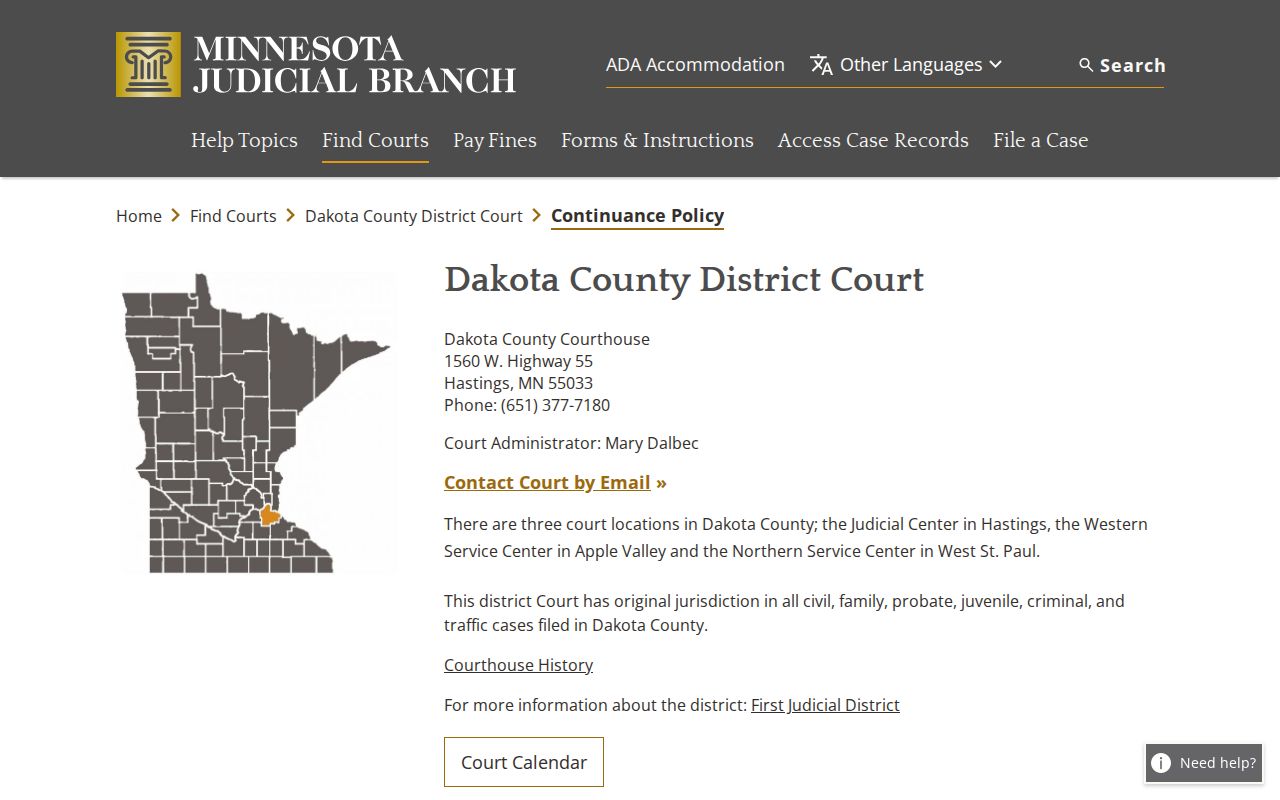
One filing label never settles the question. Check the Dakota County calendar and case events directly before assuming a hearing moved.
Dakota County Court Record Copies
Match the copy to the job. For personal reference, a plain MCRO printout of a public docket entry often suffices. It cannot stand in for the court's certified copy, which a receiving office may insist on. Exemplified records add yet another layer of authentication. Request one only when that exact form is required.
| Copy type | What it carries | Where to begin |
|---|---|---|
| Plain | Public record content without a court seal. | MCRO when remotely available, a terminal, counter, or copy request. |
| Certified | Court certification or seal. | Dakota County Court Administration copy request. |
| Exemplified | Additional judicial authentication. | Dakota County Court Administration with the needed request details. |
All of this concerns the court's own record. A city agency's report sits elsewhere, under a different office with its own request process.
Dakota County Court Record Route
For the official Dakota County copy route, use the Judicial Branch Copy Request page, which lays out how to order plain, certified, or exemplified court records.
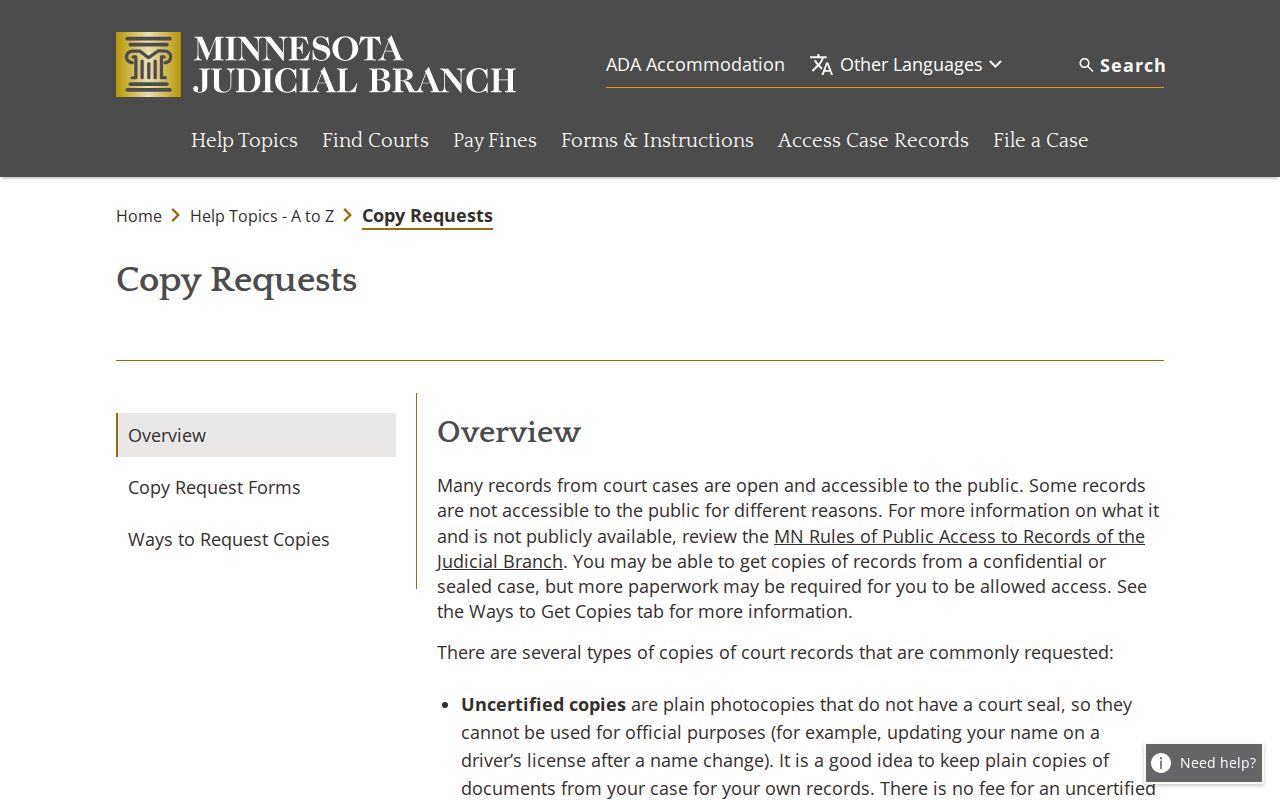
The request process lets you pick a plain, certified, or exemplified record. Access decisions on restricted material stay with the court itself.
Dakota County Court Record Access
The Judicial Branch access page puts it plainly. Courthouse electronic terminals give the fullest public access to case records. Counters handle paper files stored locally. Dakota County runs three locations, so ask the right division where a paper or limited-access record can be viewed. Public does not mean unrestricted. You may not be able to copy, photograph, or share every image you see. Guard personal identifiers, follow courthouse instructions, and ask Court Administration about copying, certification, or anything unavailable remotely.
Public Access and Sealed Records
Court files are not ordinary county data. Minnesota's Rules of Public Access to Records of the Judicial Branch govern them instead. Rule 4 builds the framework for what the public can reach. Rule 8 handles remote access. It names categories of court records that are confidential or blocked from online view. A file can be public overall while certain documents stay off the internet. Partial availability is normal, not a red flag.
Key rules:
Minnesota Public Access Rules 4 and 8 establish the general framework and remote-access limits for judicial records.
Confidential-information forms protect restricted identifiers in a filing; they do not function as a request to unseal a record.
ADO600 adoption-access instructions and the related adoption procedure are separate from ordinary MCRO document search.
Sealed, confidential, and remotely unavailable mean three different things. Your Dakota County route may be a courthouse terminal, Court Administration, a copy request, a restricted-information form, or an access order. Switching search tabs cannot get around Rule 8's limits.